09/07/2024 | Open Spaces | 5 min

GODELMANN eco-paving: Saves on sewage charges and promotes sustainable construction

Responsible management of rainwater relieves the burden on sewerage systems and treatment works, reduces the risk of flooding and promotes groundwater recharge. Many local authorities already incorporate such measures into their building regulations. Split wastewater charges provide further incentives: here, the costs for sewage and rainwater are calculated separately. Eco-paving is the ideal choice for paving surfaces in this context. We provide an overview of the key points.
1
 

Water-permeable and sustainable
GODELMANN eco-paving

GODELMANN’s eco-paving stones are the perfect choice for anyone who values sustainable and environmentally friendly solutions. These paving stones are highly permeable, which promotes the natural infiltration of water and helps to replenish our groundwater, rather than allowing the water to disappear into the sewer system. 

Our symbols featuring a water droplet indicate the paving stones’ water-permeable properties. In addition, our stones offer a wide range of other beneficial features. 

 GDM.SCADA ornament proActive nativo Grey proDrain, proPower 5, multi-generational housing in Kümmersbruck
2
 
GDM.SCADA ornament proActive nativo, Grey, proDrain, proPower 5

Key features
eco-friendly paving
 

Water permeability

Our eco-friendly paving is always water-permeable, which means that rainwater can seep through the paving surface into the ground rather than running off directly into the sewer system. This reduces the strain on the sewerage system, minimises the risk of flooding and promotes groundwater recharge.

Reduction of heat islands

By choosing light colours and reflective materials, eco-friendly paving can help to lower surface temperatures and thus mitigate the urban heat island effect. This improves the microclimate and reduces energy consumption for cooling in surrounding buildings.

Durable and low-maintenance

Eco-friendly paving is often more durable and requires less maintenance than conventional drainage systems, such as gutters and drainage shafts. Its resistance to weathering and mechanical stress makes it a cost-effective option.

Modern driveway, city villa, GDM.DRAIN stone proActive nativo Grey proDrain
3
 
GDM.DRAIN stone proActive nativo, Grey proDrain

Optimal infiltration
The joint and bedding
 

A water-permeable sub-base is essential for an eco-area. Without it, rainwater and condensation cannot drain away properly. A simple soil test can help determine whether your sub-base is suitable for a potential eco-area.


Laying, joint width and number

Joints allow rainwater to seep back into the ground quickly, thereby completing the natural water cycle. More or wider joints allow more water to pass through. The joint width in permeable paving depends on the specific paving system. Our tip: Choose one of the many GODELMANN eco-paving options with concealed spacers, which guarantee a joint width suitable for water infiltration. 

Water-permeable jointing material

The jointing material plays a crucial role in infiltration. It must not contain any fine particles smaller than 1 mm (0-grain), as these significantly reduce water permeability. The uniformly mixed joint material, made of hard stone for permeable joints or substrate for greenable joints, is swept in completely whilst dry. The joints must be filled continuously as the laying progresses to secure the pavers in place.

Sustained drainage capacity

To ensure the long-term permeability of the paved area, regular inspection and maintenance are required. Surface runoff should be channelled in a cost-effective and environmentally sound manner into vegetated side areas or drainage troughs. Passage through the living topsoil promotes the purification of the water. If drainage into the surrounding areas is not possible, a connection to the sewer system may be required as an emergency drainage measure.

4
 

Advantages of eco-paving 
Reduced water charges

The greatest advantage of eco-paving lies in the combination of water permeability and exceptional stability. The surface is not only walkable, slip-resistant and suitable for vehicle traffic, but also prevents flooding and water damage. The natural infiltration of rainwater relieves the burden on the public sewerage system and improves the microclimate near the ground. A water-permeable, unsealed surface therefore promotes an environmentally friendly environment. For this reason, many local authorities now reimburse sewage or stormwater charges for unsealed surfaces. 

Check with your local authority!

Fact box

Sewage charges are based on fresh water consumption. The amount of the rainwater charge depends on the size of the built-up and paved areas connected to the sewerage network. The charges are calculated on the basis of the sealed area of the property. This is usually the actual degree of sealing, which is determined using aerial photographs or on-site measurements. Anyone who reduces the sealed area of their property through de-sealing, so that it is smaller than officially determined, can further reduce their costs in a targeted manner. Acting in an environmentally responsible manner pays off. 

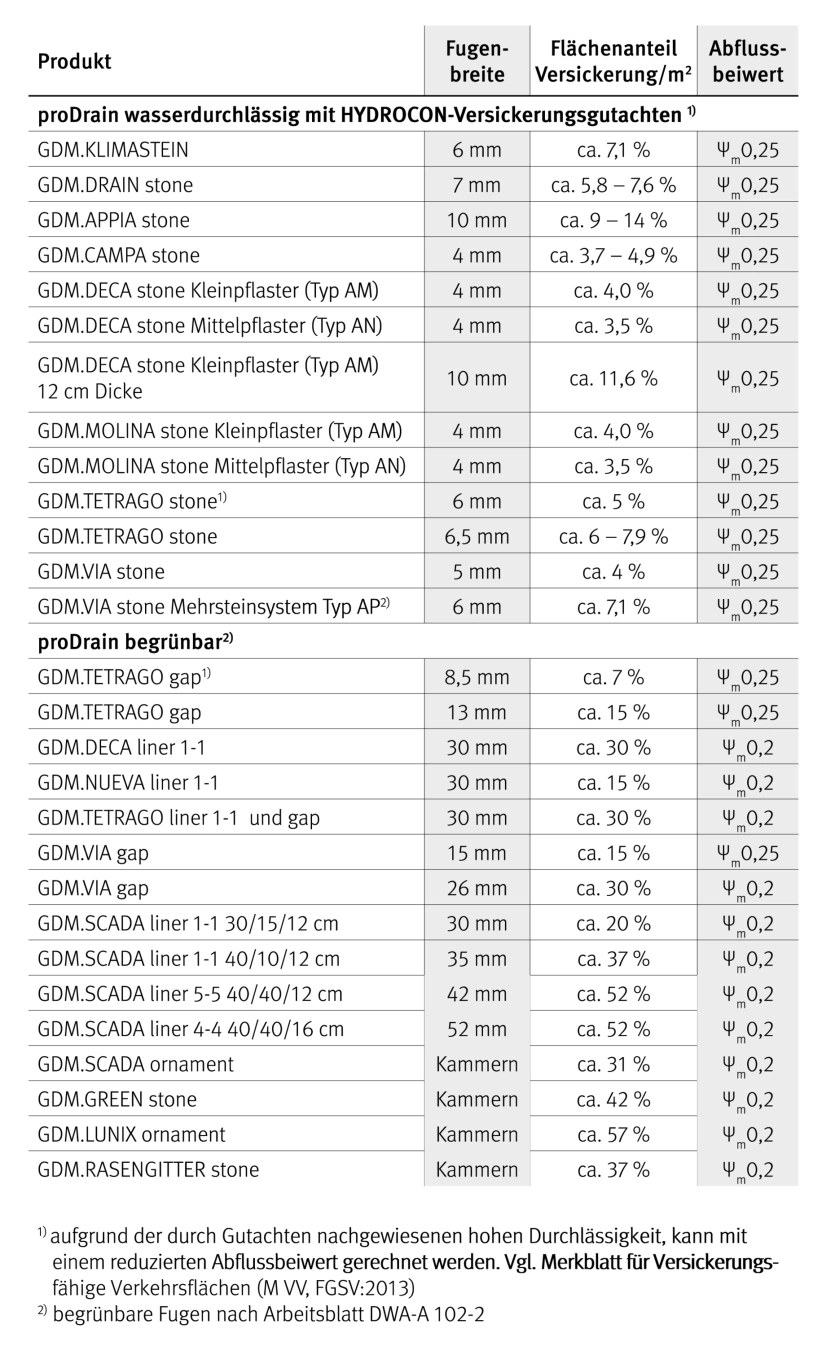
Runoff coefficient

The runoff coefficient refers to the proportion of rainwater that runs off the surface. The lower the value, the lower the surface runoff and the greater the proportion of water that infiltrates the ground. The magnitude of the runoff coefficient depends not only on the paving stone or slab selected but, above all, on local conditions. In particular, these include the infiltration capacity of the building materials used for the base course, bedding and joints; the permeability of the subsoil; any contamination; the gradient of the surface; and local rainfall conditions. In the case of grass-paving, the jointing substrate used also plays a decisive role. For this reason, the specified ‘average runoff coefficients’ can only represent an average. The actual values for each individual surface may vary upwards or downwards.

Expert reports confirm that our products exceed the required infiltration capacity of 270 l/(s·x·ha) for areas without a sewer connection. Even though the infiltration capacity usually

All GODELMANN eco-paving at a glance:

Gardens of Ideas

Visit one of our five inspiration gardens and be inspired!

Idea Gardens at a glance

Products

Eco paving
Our ecological paving is versatile and proactive. They can be planted, used as water-permeable paving or as an efficient surface system for water treatment. Our evaporation-active concrete blocks also help to improve the urban climate.